


“Domain search” sounds like one job, but it’s really four, and each needs a different tool and a different set of inputs. The first is the plain availability check. You have a name and want to know if it’s registered, which extensions are open, and what each costs. For that you need live registry data instead of cached results, wide TLD coverage, and a bulk mode the moment you’re checking more than a handful of ideas. The second is name generation. You have a concept but no name, so you need something that takes keywords, an industry, or a plain description and hands back candidates you wouldn’t have reached alone, with availability filtering baked in so you don’t fall for something that sold in 2011.
The third is expired and dropping domains, and it’s the one that punishes beginners. Here you’re not searching for a name, you’re filtering a database, so you need metrics: age, referring domains, Trust Flow or DR, Wayback history, indexed pages, spam score. You also need to know where a domain sits in its lifecycle, because grace period, redemption, and pending delete each demand a different move. The fourth is the aftermarket hunt, where the name is taken and somebody will sell it. That needs a budget, an ownership lookup, escrow, and patience. Underneath all four sits the step everyone skips and regrets: a trademark check and a handle sweep before the money moves.
How we picked the tools on this list
There’s no shortage of domain tools, so what did we weigh? Data freshness, first. A tool that calls a name available when it went pending delete four days ago has wasted your afternoon. Then whether it does one job properly instead of eight badly, and whether it ever tells you no, because anything that only surfaces reasons to buy is a sales page wearing a search bar. We skipped the free generators that weld “hub,” “ly,” and “ify” onto your keyword. You’ve seen those results. But we got a sneak preview into something new below, which we have to show everybody!
Best Overall: DomainNameRegistration.com
- Best for: Searching for a domain from scratch
- Speed: Insanely fast, typically 2ms per lookup
- Free to search: Yes
- Best part: Real-time generation, voice search, instant palettes so you can visualize it
Start with the number, because it reframes everything else: 2 milliseconds per lookup. That makes it the fastest domain search on earth, and it isn’t a spec sheet flex. At that speed, searching stops being something you submit and becomes something that simply happens. No button. No spinner. No half-second pause where you lose your train of thought and forget your third idea.
That speed is what makes the real-time generation work. Type a fragment or describe the business and names appear as you go, already checked against the registry, so every candidate on screen is one you can actually have. Most generators hand you a list and let you find out which ninety percent are dead. This one never shows you a name you can’t buy.
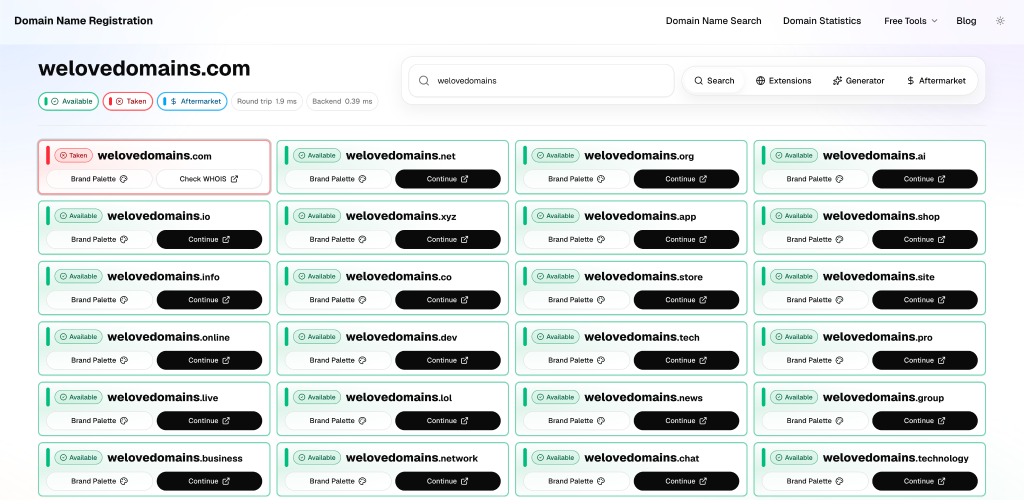
Then there’s voice search. Rather than typing a candidate, you say it out loud and the tool checks availability from what it hears. Sounds like a gimmick? It isn’t. Saying a name aloud is the oldest naming test there is, and this makes that test the search itself. If the transcription comes back as something you didn’t intend, congratulations, you just found your spelling problem six months before your customers would have.
They also have very generous API limits, allowing up to 5k queries at a time with a limit for everyone at 100,000 per minute across their API, MCP, NPM package and Chrome extension.
Lastly, the color palettes. Land on a name and the tool surfaces palettes drawn from the associations the word carries, rendered in milliseconds, faster than you can finish typing the name that produced them. “Ironvale” returns something very different from “Peachlight.” Small feature, outsized effect, because it moves you from an available string of characters to the beginnings of a brand in a single step.
Downsides? It won’t replace a dedicated expired domain platform, like Odys Global. That’s just not what it is for.
Best marketplace for aged domains: Odys Global
- Best for: Buying authority instead of hunting for it
- Free to search: Browsing the marketplace needs an account
- Best part: Every domain is vetted before it gets listed
Everything else here hands you raw data and leaves the judgment to you. Odys Global runs the other way round. Vetting happens before a domain reaches the marketplace, so the spam check, the archive history, and the link profile audit are already done by the time you see a listing. You’re browsing the shortlist, not the haystack.
That makes it a different purchase entirely. Elsewhere you’re buying a lottery ticket and doing your own diligence to shorten the odds. Here you’re buying a domain that already survived somebody else’s, history documented rather than implied. Instead of planting on dry ground, you start on soil already carrying age, trust, and a link profile someone else spent a decade building.
Downsides? Curation costs money, and these are not cheap. Fifty dollars and a free weekend? Start at ExpiredDomains.net instead.
Best for vetting: SpamZilla
- Best for: Not buying a disaster
- Free to search: Limited
- Best part: Spam scoring and archived content history
Four hundred referring domains means nothing if 380 come from a link farm and the site spent 2019 as a pharmacy spam page. SpamZilla scores spam signals and surfaces what the site used to be. Buying with real money? This is the step that saves it. The downside: it assumes you know what the scores mean.
Best for bulk: Namecheap Beast Mode
- Best for: Defensive registrations and systematic checks
- Free to search: Yes
- Best part: Prefix, suffix, and price filters at scale
Paste in hundreds of names, layer on prefixes and suffixes, filter by extension, character count, and price, then export. This is what you reach for once the brand is chosen and you’re locking down everything around it. A spreadsheet with a search engine attached, which is the point, and also why it’s no fun for brainstorming.
Best free expired database: ExpiredDomains.net
- Best for: Learning the expired market
- Free to search: Yes
- Best part: Nothing else gives you this much data for nothing
It aggregates pending delete lists, auction feeds, and dropped domains, then hands you dozens of filters: backlinks, age, keyword, TLD. The interface looks like 2009 and the learning curve is real. Spend a week here before you spend a dollar anywhere, because this is where you develop a feel for what a good expired domain looks like.
Best for the aftermarket: GoDaddy Auctions
- Best for: Inventory nobody else has
- Free to search: Browsing yes, bidding needs membership
- Best part: The closeout section
Expiring GoDaddy registrations and 50+ other registrars land here first, so the pool is genuinely different from everywhere else, and closeout regularly turns up usable names cheap. Set a walk-away number before you start. Anything obviously good attracts a crowd, and auction rooms are built to make you forget your budget.
Outlook on domain searching in 2026
Naming something new? Start at DomainNameRegistration.com and let the speed, the voice search, and the palettes carry the creative load. Want authority without the hunt? Odys Global. Locking down variations? Beast Mode. Hunting authority yourself? Learn on ExpiredDomains.net, vet through SpamZilla, then bid on GoDaddy Auctions with a number you’ve already written down.
One last thing, and it’s the cheapest step in the process: run the trademark check before you pay. It’s the only mistake here that can cost you the whole brand.